
Life does not send a calendar invitation before something shifts. You do not schedule the season when who you were stops fitting. You do not plan the morning you wake up and realize you have been moving through your days on a kind of autopilot, or the moment something that used to feel certain quietly stops feeling true.
The in-between arrives when it arrives. The need for orientation, for support, for a place to understand what is actually happening, has its own timing. It does not align with enrollment windows or cohort start dates or a sequence built around someone else's version of readiness.
The Embodiment Laboratory was built with that reality at its center.
You enter when the timing is honest. You work with what is relevant when it becomes relevant. You move at the pace your awareness and your process actually allow.
The Simplest Way I Can Say It
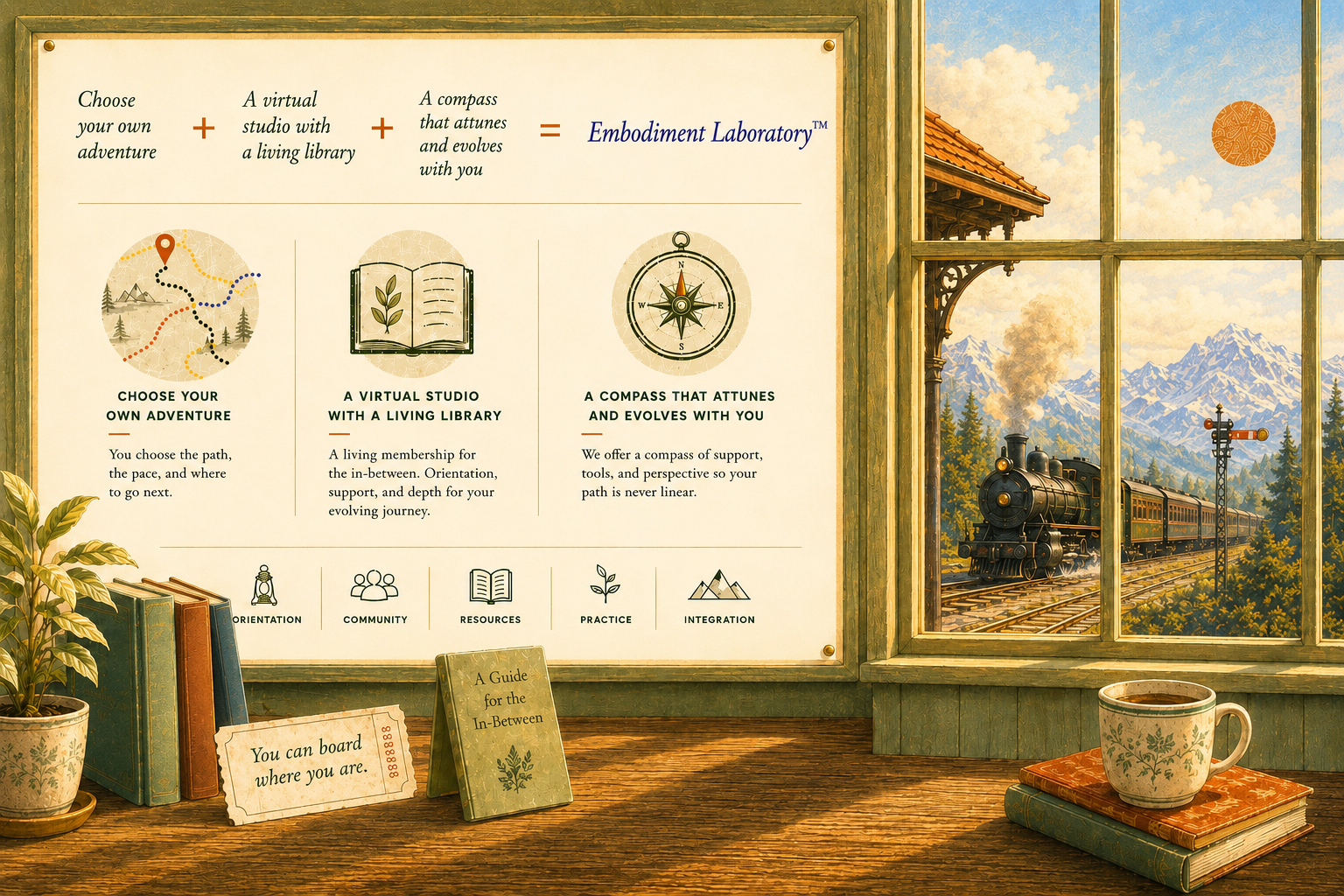
The closest shorthand I have is the Choose Your Own Adventure books.
The book was the same. The terrain was shared. But the path was not laid out in a single line. Where you went, which page you turned to, what you encountered and when, depended on the choices you made as you moved through it. Two people could enter the same book and come away with different journeys. Neither path was wrong. Each one was shaped by the reader's own decisions in real time.
Worth noting: in those books, the choices were not limitless. The author had built the world. The options existed inside a designed structure. That constraint is not a flaw in the metaphor. It is the point. The Embodiment Laboratory has a map. The territory is built and tended. What you do inside it, where you go and when, belongs to you.
What You Are Actually Entering
The content inside the Lab is organized around the Embodied Evolution Practice, a framework built through lived experience rather than theory. I built it because I know what it is to be in a season where the old map is gone and the new one has not introduced itself yet.
You enter where something resonates. You reflect on where you are. You choose what you need from that honest read, and you move accordingly. Where you go next is determined by where you actually are, not by what comes after it in a list.
That choosing is not incidental to the practice. It is the practice.
What This Means in Reality
There is no cohort to keep pace with. There is no external sequence that decides your readiness before you do. There is no predetermined place you are meant to arrive by some appointed end.
That does not mean you are floating without form. The structure is steady. What holds the space:
Self-paced access to the practice and the resource library
A monthly online gathering, where we reflect on what you are navigating and make sense of it together
The Heartbeat community, alongside people who are in the in-between with you
Orientation and integration support throughout
That rhythm is consistent. What you bring to it, and what you take from it, is yours to navigate.
The content grows as I create. You have access to everything already inside and to whatever I add over time. There is no version of this where you fall behind, because there is no external timeline deciding your pace.
Over time, the evidence shows up in the small things. You notice a difference in how you respond to situations that used to move through you in a predictable way. Where there was frustration, there is now a little more space, a glimpse of what is underneath it, or simply a moment of less.
You arrive at a fork you have stood at before, and instead of taking the familiar path toward the outcome you already know, something in you gets curious. What happens if you say something different this time, or do nothing, or try the other direction. Maybe this time you do not have to follow the old groove all the way to the old ending. Maybe there is a slightly less painful version of what you know. Maybe there is something you could not have predicted. Either way, you feel the difference between moving from pattern and moving from awareness. That difference, noticed once, then again, then again, is how trust in your own process begins to build.
When you feel grounded, self-trusting, and clear enough in your uncertainty to move forward on your own, when you know and trust your process, that is a natural completion. The space supports your process. It does not extend it beyond its usefulness.
Why It Was Built This Way
I built it this way because I kept returning to the same question: who am I to say which lesson you need?
Your awareness determines where you go next. Your experience tells you what is relevant. Your body, your process, and what life is currently asking of you are more accurate guides to which content will actually land than any sequence I could design in advance.
It is a little like going to the gym. You show up when your body needs it. You choose what to work on based on what you are carrying and what you can hold that day. The gym does not decide. You do. The equipment is there. The space holds you. The work is yours.
The same principle lives inside the Lab. The content is there. The rhythm holds you. The guide is present. What you work with, and when, belongs to you.
How You Know If This Is the Right Place
There are different places the mind lands when considering something like this. One of the most common goes: it sounds right, but I am not sure I am ready.
Readiness, in the conventional sense, is not really the question. The question is whether something is already shifting, and whether you want a place to work with it that does not require you to have it figured out first.
You may already understand why a space like this needed to exist if you have ever:
Been inside a program that moved faster than your integration could follow
Felt like the wrong person inside the right room
Kept up on the outside while quietly losing the thread on the inside
The Embodiment Laboratory is for people who are already aware, already capable, already doing some version of the work, and still finding that awareness alone is not closing the gap. The content meets you where you are. The practice asks you to keep locating yourself honestly as you move through it.
Entry is by application, which exists to make sure the timing and the fit are right for both sides. There are no trick questions. The more honest your answers, the clearer the fit becomes.
That is the heart of it.
Two Ways to Begin
Where Am I? Workbook — if something here is landing but you want to locate yourself more clearly before deciding anything else, this is where that happens. Thirty-seven pages, four entry moments, reflection prompts designed to show you where you are so what comes next becomes clearer on its own.
The Begin page — if something in you is already answering, this holds everything you need to understand the space, the investment, and the application.
There is no wrong starting place. There is only the honest one.